
By Seemab Akbar8 min readAI Solutions
On two phone calls each, the typical wait before an AI receptionist answered ran from 1.6 seconds to 4.6 seconds, and three of the nine lines left the caller waiting more than five seconds at least once. Ours answered in 1.6 and 1.9 seconds, never talked over the caller and never left one waiting five seconds.
Who this is for: Owners and office managers choosing an AI receptionist, and anyone who wants a number to check before trusting one with the phone.
In this guide
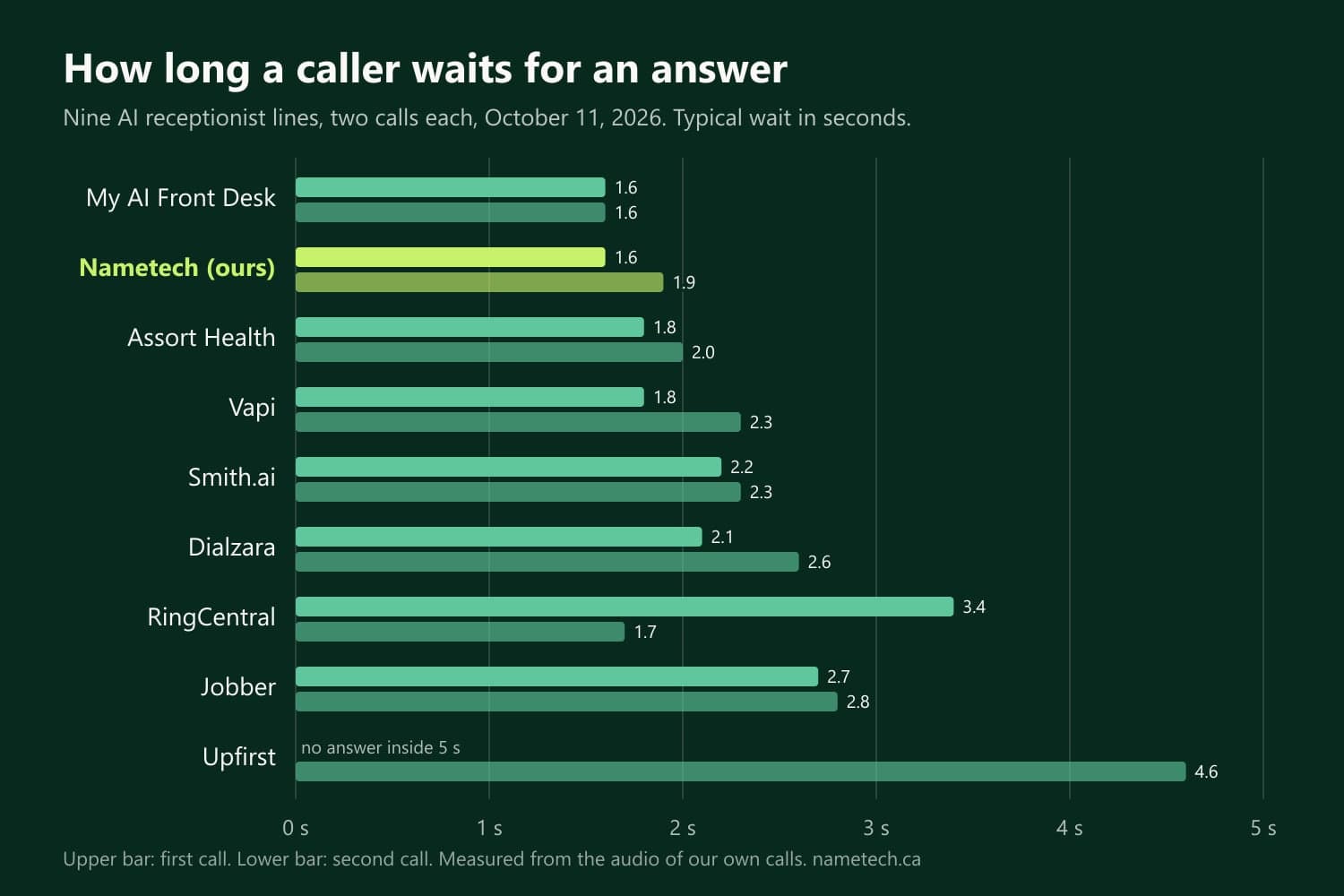
Every company that sells an AI receptionist says it sounds natural. That is hard to check from a web page. One part of it can be checked with a stopwatch: after you stop talking, how long is it before the thing answers? A second of silence on the phone feels polite. Three seconds feels like the line has dropped.
So we phoned eight AI receptionist lines that their makers publish for anyone to try, phoned our own line the same way, and timed all of them. We put our own number in the table with everyone else's, including the parts that did not flatter us.
What we did
On October 11, 2026 we called each line twice. The caller was an AI of ours playing the same person every time: someone who found the business online and wants to become a customer. It was not told whose line it had dialled, and it asked what a new customer would ask. Each call ran for up to two minutes. Ours was measured on our own test number, which runs the same receptionist with the same settings as our business line.
One program measured the audio of every call the same way, with the two voices on separate channels. The wait is the time from the caller's last sound to the receptionist's first sound. A line talked over the caller when it started speaking while the caller was mid-sentence and the caller kept going. Once a call was measured its audio was deleted, so only the numbers remain.
The results
| Line | Typical wait, two calls | Talked over the caller | Waits over 5 s | Slowest wait under 5 s |
|---|---|---|---|---|
| My AI Front Desk | 1.6 s and 1.6 s | 5 times | None | 4.8 s |
| Nametech (ours) | 1.6 s and 1.9 s | Never | None | 2.4 s |
| Assort Health | 1.8 s and 2.0 s | 1 time | None | 2.1 s |
| Vapi | 1.8 s and 2.3 s | Never | None | 3.5 s |
| Smith.ai | 2.2 s and 2.3 s | Never | None | 2.4 s |
| Dialzara | 2.1 s and 2.6 s | 2 times | 1 (longest 6.3 s) | 3.2 s |
| RingCentral | 3.4 s and 1.7 s | Never | 1 (longest 7.7 s) | 4.9 s |
| Jobber | 2.7 s and 2.8 s | 1 time | None | 3.4 s |
| Upfirst | None under 5 s, then 4.6 s | Never | 5 (longest 7.5 s) | 4.6 s |
The typical wait is the middle value of the handovers on a call, and a call held up to nine of them. We show both calls and not an average on purpose: the same line can differ a great deal from one call to the next. RingCentral's typical wait was 3.4 seconds on one call and 1.7 on the other. Ours was 1.6 and 1.9.
What stood out
- Nobody answered in under a second. The fastest typical wait on any call was 1.6 seconds, measured from the caller's side of a real phone call. A phone network sits in the middle of every one of these numbers, ours included.
- The typical wait hides the bad moment. Three lines left the caller in silence for more than five seconds at least once, and the longest silence was 7.7 seconds. A caller does not remember your typical wait. They remember the one time they said hello twice.
- Fast is not the same as polite. The line with the shortest typical wait also talked over the caller five times on one call. Answering quickly is easy if you do not wait to find out whether the caller has finished.
- Three lines did both things right on both calls: no talking over the caller and no wait over five seconds. They were Vapi, Smith.ai and ours, and of the three ours was the quickest.
The nine lines, one by one
If you are weighing one of these against another, this is what each did on its two calls. Nothing here goes beyond what the audio shows.
- My AI Front Desk. A typical wait of 1.6 seconds on both calls, the shortest of the nine. On the second call it began speaking over the caller five times, and its slowest answer took 4.8 seconds.
- Nametech. 1.6 and 1.9 seconds, slowest answer 2.4 seconds, never over the caller and no wait over five seconds. It is the receptionist inside NameCRM.
- Assort Health. 1.8 and 2.0 seconds. No line had a shorter slowest answer: 2.1 seconds. It talked over the caller once.
- Vapi. 1.8 and 2.3 seconds, never over the caller and no wait over five seconds. Its slowest answer took 3.5 seconds.
- Smith.ai. 2.2 and 2.3 seconds, and steady: its slowest answer, 2.4 seconds, was barely slower than its typical one. It never talked over the caller.
- Dialzara. 2.1 and 2.6 seconds. It talked over the caller once on each call and left one silence of 6.3 seconds.
- RingCentral. The widest swing of the nine: 3.4 seconds on the first call and 1.7 on the second, with one silence of 7.7 seconds on the first. It never talked over the caller.
- Jobber. 2.7 and 2.8 seconds, with one talk-over and no wait over five seconds.
- Upfirst. The slowest on these calls: no answer inside five seconds on the first, a typical wait of 4.6 seconds on the second, and five silences longer than five seconds across the two.
Our own first run was not flattering
We ran this test once before, on October 9. Our typical wait was 1.7 seconds, which looked fine. But one answer took 4.8 seconds, and we talked over the caller twice. We spent two days on that before running the test you see above, which is the advantage of holding the stopwatch.
Then we found the stopwatch was wrong too. Our measuring program was quietly dropping any wait longer than five seconds, so the first table flattered everybody, us included. It now counts those waits and shows them in their own column. If you ever publish a comparison, check what your own tool throws away.
What this test cannot tell you
- These are demonstration lines. A company's demo line is not the same as a receptionist set up for a paying customer, and each demo plays a different kind of business.
- Two calls is a small sample. The two typical waits beside each name show how much one line can move between calls. Treat the table as a snapshot of one afternoon, not a ranking for all time.
- Speed is not the job. This measures waiting and interrupting. It says nothing about whether the answers were right, whether a booking was made or what the business received afterwards. We test those separately on our own line and we did not grade anyone else on them.
- The caller was an AI. It let us ask every line the same kind of questions in the same manner. A person would have been less consistent and might have been more patient.
How to time one yourself
You do not need our program. If you are choosing an AI receptionist, call its demo line with a stopwatch and do this:
- Ask a question that needs a real answer, then count the seconds from when you stop talking to when it starts.
- Do it five times on the same call. One fast answer proves little, and the slow one is the one your callers will meet.
- Pause in the middle of a sentence, then keep going. See whether it waits for you or answers the half you said.
- Give it an email address or a phone number slowly, in pieces, and see whether it lets you finish.
- Call again from a noisy place, such as a car or a cafe. That is where most of them slow down.
What ours does besides answer quickly
Speed only gets a caller to the second sentence. This is what happens after it on our line:
- It knows who is calling. It reads the caller's record before it speaks: open deals, recent texts, upcoming meetings and past calls.
- It books while the caller waits. It books, moves or cancels meetings in your real calendar during the call, checked against your open hours.
- It says what it is. Every call opens by saying it is an AI assistant and that the call is recorded.
- It leaves you the whole call. The recording, a summary and tasks land on the client's record, and the caller gets a recap text when a meeting is booked or a callback is owed.
- It works in more than English. It understands French, Hindi, Urdu and Punjabi callers, and replies aloud in French or Hindi.
- You can step in. Listen live from your phone, whisper an instruction the caller cannot hear, or take the call over.
It comes inside NameCRM, the client system we run our own business on, and only with it. What it does on a call is on the AI receptionist page, the story of it on our own line is in the case study, and how it compares with a live answering service or plain voicemail is in this comparison. If you would like to hear it, call us at 604-900-2060 and let it ring. If you would like to know where AI would pay off in your business first, the AI Readiness Check takes two minutes.
Want this worked out for your business?
There is no price list here, because every build is different. The free 30-minute assessment comes first; then you get a written estimate before any work starts, with GST added on top.
Book the free assessment